SEARCH RESULTS
55 results found with an empty search
- Multi-Year Grant Videos
Con Alma Health Foundation partnered with the Sancre Productions team to create four short videos that illustrate how our grants improve the lives of people living in New Mexico. These compelling videos show how four nonprofits used our multi-year grants (three year grants ending in 2017) to help people access health care, protect the confidentiality of adolescent health care and support community health workers to help those in need. We are proud to highlight the work of the following nonprofits: New Mexico Alliance for School-Based Health Care ($150,000) towards Improving Access to and Confidentiality of Sensitive Services for Adolescents and Others, a coordinated network of more than 120 members and governmental agencies advocating for changing the policies and practices of commercial health-insurance companies to protect the confidentiality of adolescent health care New Mexico Center on Law and Poverty ($150,000) to the New Mexico Healthcare Access Project, ensuring that low-income individuals have access by removing barriers to enrolling, accessing or renewing Medicaid or Exchange coverage; addressing coverage gaps in healthcare; and promoting healthcare coverage and services for low-income Native American children and families New Mexico Community Health Worker Association ($150,000) towards Bridging the Health Equity Gap, a collaborative approach for recruiting, training, and mentoring lead health workers with certification and grandfathering efforts of the 2014 Community Health Worker Act while seeking innovative credentialing opportunities with community colleges and others Vision for Dignity, Access, and Accountability (VIDA) in Healthcare ($150,000) towards establishing a Bernalillo County Health Safety Net for those who remain uninsured and without access to affordable healthcare services by working with organizations in Albuquerque’s South Valley on coalition building and public education on the need to expand access Be sure to check out Sancre Productions ‘ work with the Rio Arriba County Health Council uniting the communities of Northern New Mexico with the programs and resources available locally that are working to address opioid use disorder among residents and their families: https://www.anewnormal.life/
- Grandparents Raising Grandchildren in New Mexico: Understanding the Trend & Stemming the Tide
The number of grandparents raising their grandchildren continue to rise in New Mexico and across the country. While the state has a strong tradition of extended families caring for members, grandparents, and other extended family members, are increasingly assuming primary care of their grandchildren because parents are unavailable or unwilling to be involved. Download full report We have commissioned this study to help provide an understanding of the causes and issues behind the growing trend and how stakeholders, including the families affected, can best support this population. The report, Grandparents Raising Grandchildren in New Mexico: Understanding the Trend & Stemming the Tide, offers insight into the statistics behind the stories as well as recommendations for moving forward. “New Mexico has wonderful organizations working hard to help grandparents raise grandchildren – a critical need here. We also need people to work on addressing the root causes so children can live and thrive in intact families,” said Dolores E. Roybal, Con Alma’s executive director. “New Mexico’s history of extended families supporting one another is a valued tradition here, but grandparents who are alone in raising their grandchildren usually live in poverty while still working and navigating school and health-care systems.” Key findings of the report include: More households with three and four generations are living under one roof. Hispanics make up 53 percent of New Mexico’s grandparents raising grandchildren. Native Americans represent 9 percent of New Mexico’s population and 20 percent of grandparents raising grandchildren. Native American grandparents have unique challenges in navigating two legal systems. The lack of parental involvement is due to a number of factors, including substance abuse, incarceration, divorce, mental-health diagnoses, domestic violence and military deployment. In 2015, more than 26,200 grandparents in New Mexico were responsible for the grandchildren living with them, and almost 61 percent were younger than 60. “This trend has been steadily growing for many years, and there is no fast solution. We need New Mexicans to come together and work on policies, advocacy and long-term funding investments to create stronger families,” Roybal said. Recommendations moving forward: Analyze and address the primary social determinants of health factors (poverty, race, ethnicity, education) and develop policy initiatives related to economic development and wage equity, racial and ethnic justice and parity, and educational equity and opportunity Analyze root causes to identify key issues, models of excellence and policies that move populations toward equity – when everyone has an equal chance at living a healthy life Connect this work with other policy work being done related to addressing health disparities in New Mexico Download Key Findings and Recommendations Download Press Release
- The Affordable Care Act in New Mexico: Community Survey Snapshot
As part of Con Alma Health Foundation’s project to assess the impact of the Patient Protection and Affordable Care Act (ACA) in New Mexico, the Foundation conducted an informal survey in the fall of 2015 to provide an opportunity for individuals around the state to provide feedback on how the Affordable Care Act has impacted them, their family, and community. Con Alma received a total of 266 responses, which provides a snapshot of respondents’ perceptions about ACA in New Mexico. This survey does not profess to represent the general public opinion about the Affordable Care Act in our state. Click for Survey Summary The community survey was distributed online, and through Con Alma Health Foundation’s website, social media, newspapers, and other means. It was also posted to several websites such as the Center for Nonprofit Excellence, Santa Fe Community Foundation, and Goodnews New Mexico, among others. Although the number of responses was small, the geographic representation was remarkable. As demonstrated in the Geographic Participation graphic, responses were received from 30 of the 33 counties in New Mexico representing 55 communities/towns/villages around the state. The geographic participation could not have been accomplished without the help of the New Mexico Alliance of Health Councils. The Alliance is comprised of 38 county and tribal health councils throughout New Mexico. This snapshot revealed concerns regarding affordability and the complexity of obtaining health insurance and demonstrates continued barriers to health care consistent with other surveys of this type. Responses were less clear about the depth of understanding of some of the benefits of health care reform under the Affordable Care Act. For example, under ACA, insurance companies cannot refuse coverage due to pre-existing conditions. ACA covers preventive services, allows young adults to stay on their parents’ health insurance plan, and includes mental health and substance abuse services as essential health benefits. As with the implementation of any major new policy, there is often a gap between what was planned and what actually occurred. With ACA, the challenges of implementation revolve around cost, and the complexity of the Affordable Care Act itself. Suggestions from survey respondents on what can be done to improve the implementation of ACA were largely focused on increasing affordability and reducing the complexity of obtaining health insurance. Health literacy and continued outreach and education were specific strategies recommended by respondents to improve the implementation of ACA in New Mexico.
- How to Write Effective Proposals
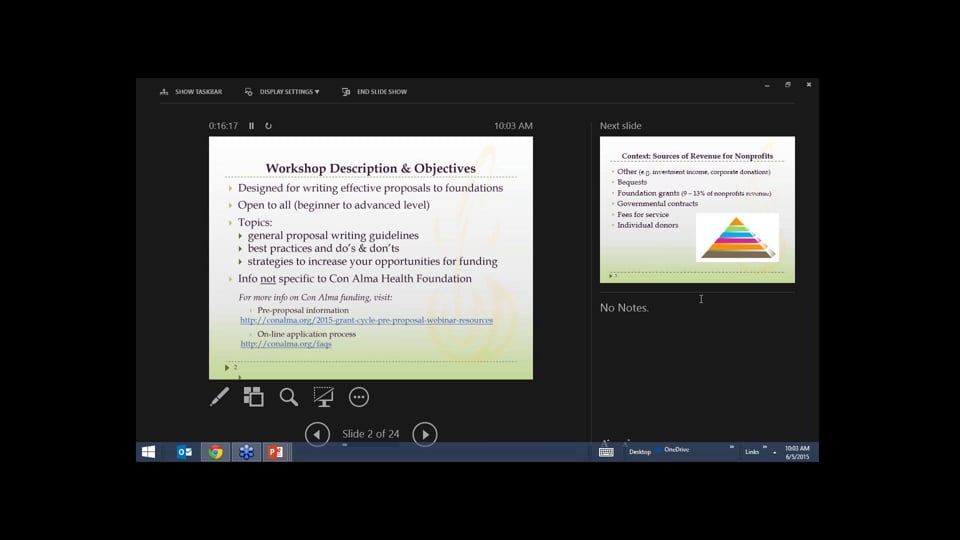
This workshop is designed for writing effective proposals for foundation funding (non-governmental). It is open to all individuals (beginner to advanced level). Topics: general proposal writing guidelines, do’s and don’ts, and strategies to increase your opportunities for funding. Information is not specific to Con Alma Health Foundation, but focused on grantwriting in general. Dolores E. Roybal, Executive Director, Con Alma Health Foundation. Dolores has over 35 years of experience in grantwriting and in working with the nonprofit and philanthropic sector. She has also taught grantwriting at the college level (undergraduate and graduate), and conducted numerous grantwriting workshops for nonprofits from both the grant writer and funder perspectives. Download Presentation
- Advancing Health Equity in Rural Communities
HPHP: Advancing Health Equity in Rural Communities from Con Alma on Vimeo . Advancing Health Equity in Rural Communities with Charlie Alfero, Executive Director of Hidalgo Medical Services – Center for Health Innovation Thursday, November 20, 20142:30 p.m. – 4:30 p.m. Inn and Spa at Loretto211 Old Santa Fe TrailSanta Fe, NM 87501
- Native American Health Care Reform Guide
Con Alma Health Foundation is proud to release this updated guide outlining how Health Care Reform affects Native Americans. The Native American Health Care Reform Guide: Implications of Health Care Reform for Native Americans in New Mexico helps to understand the changes that will take place through Health Care Reform and helps people to maximize benefits from the specific provisions of the new law that apply to Native Americans. It assists individual Native Americans, Native communities, Tribal governments, the Indian Health Service, Tribal 638, and Urban Indian Health Programs to recognize the opportunities to expand and strengthen Indian health systems through implementation of Health Care Reform. The Native American Health Care Reform Guide outlines immediate and upcoming changes by population category, including for individuals with health insurance, children and young adults, people with pre-existing conditions, people on Medicare, small employers, people using Indian Health Service and tribal governments. Roxane Bly, an American Indian health-policy consultant who wrote the guide for Con Alma Health Foundation, said it’s critical for American Indians to understand that even though they are not required to have health insurance, it’s important to get as many American Indians covered as possible through the health-insurance exchange or Medicaid expansion. “The Indian Health Service is not health insurance,” she said. “It’s a fragile system where people can get some services, but it’s unreliable and underfunded. When Indian people have coverage, tribal providers can bill for those services and put money back into the system. It strengthens the Indian health system and could potentially allow for the expansion of services.” Key information from the guide: Employers with at least 50 full-time employees are required to offer minimum essential coverage that satisfies the individual mandate. Tribal governments are not exempt from this requirement. American Indians enrolled in Medicaid cannot be required to share costs if they are eligible for IHS services or have used IHS in the past. American Indians paying for insurance through the health-insurance exchange do not have to pay co-pays or deductibles if their income is less than 300 percent of the federal poverty level. Right now health insurers can’t arbitrarily cancel your coverage if you get sick. Insured people can now get preventive care, such as annual exams and cancer screenings, with no out-of-pocket costs. Employers can receive a tax credit for up to 35 percent of what they spend on coverage for employees. This credit increases to 50 percent in 2014. In addition to the health-care reform guide, Con Alma Health Foundation brought people together in four convenings to learn more about how the federal Affordable Health Care Act will affect them and the people they serve. Con Alma held meeting s in Albuquerque , Las Cruces , Clovis, and Gallup so people from across the state had an opportunity to learn from one another and ne twork. “After holding meetings across the state, we’ve learned that people are hungry for information about how federal health-care reform will affect them,” said Dolores E. Roybal, Con Alma’s executive director. “We developed this guide as an easy way for people to learn how federal health-care reform will impact them.”
- EVERYONE WINS: Maximizing the Economic Impact of Health Care Delivery in New Mexico
According to a new report about the economic impact of health care reform in New Mexico, increased access to health care will result in new jobs, increased incomes and a healthier population. EVERYONE WINS: Maximizing the Economic Impact of Health Care Delivery in New Mexico makes the case that increasing access to health care will cause a stimulus to the health-care sector that will ripple throughout the broader economy, creating new jobs and increasing income in virtually all industrial sectors. Con Alma Health Foundation, along with the Mid Region Council of Governments, U.S. Economic Development Administration, and the McCune Charitable Foundation provided funding for economist Kelly O’Donnell, Ph.D, to write a compelling report to help people understand the impact of the Patient Protection and Affordable Care Act in New Mexico. The report outlines where New Mexico is now and what it needs to do to maximize the state’s delivery of health care. The report covers topics like health care employment, health care as an economic base industry and economic impacts of health care. O’Donnell concludes the report by providing key recommendations for New Mexico to realize “the full economic potential of our state’s health care delivery system.” Download full report.